Schafskopf Rules
Schafskopf (German for "Sheepshead") is a three player game that we discovered
in college while reading through the Hoyle's card book. There aren't many three
player card games, and this one is the weirdest I have ever played. I'll try
to outline the rules of the game as best I can, but it definitely takes some getting
used to (it's worth it, though).
Deck
Standard deck, with all jokers, 6, 5, 4, 3, and 2 cards removed. This leaves 32 cards.
Rank of Cards
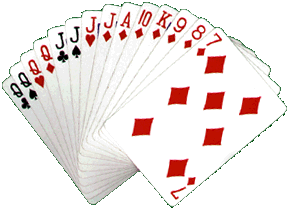
Queens, Jacks, and Diamonds are trump (that's 14 trump, or 44% of the deck).
Within the Queens and Jacks, rank of the suits are Clubs, Spades, Hearts, and Diamonds.
The remaining trump and all non-trump suits are ordered as: Ace, 10, King, 9, 8, and 7.
So, to be explicit:
| Trump: |
- Queen of Clubs
- Queen of Spades
- Queen of Hearts
- Queen of Diamonds
- Jack of Clubs
- Jack of Spades
- Jack of Hearts
- Jack of Diamonds
- Ace of Diamonds
- 10 of Diamonds
- King of Diamonds
- 9 of Diamonds
- 8 of Diamonds
- 7 of Diamonds
|
|
| Non-trump (remaining Spades, Hearts, and Clubs): |
- Ace
- 10
- King
- 9
- 8
- 7
|

|
This is perhaps the most confusing part of the game, so you might want to
write this down on a cheat sheet while you are learning to play.
Point Values of Cards
Each card that is taken in a trick has a certain point value, irrespective of suit:
| Ace |
11 points |
| 10 |
10 points |
| King |
4 points |
| Queen |
3 points |
| Jack |
2 points |
| 9, 8, or 7 |
0 points |
The total number of points in a deck is 120. Note that, although Queens and Jacks are the highest trump, they are worth little points. This becomes important when forming a strategy.
The Deal
The cards are shuffled, and dealt face-down as follows:
- Three to each person
- Two in the middle
- Four to each person
- Three to each person
The Bids
Starting at the dealer's left, each player has one opportunity to "Take the middle"
or "Pass", until somebody takes it or everyone passes ("Going Least").
If someone decides to take it, they can put the two cards that were dealt into the middle into their hand. They must then discard two cards (can be the same cards they picked from the middle) to return their hand to 10 cards. The other two players now play against him/her. The player who took the middle is now trying to get as many points
(as represented by the point value of each card, above) in the tricks they win during the course of the hand. The two cards the "taker" discarded are not revealed, but are included in the point total of the two players playing against him/her.
If everyone declines to take the middle, the two middle cards are set aside
(still face-down) and everyone is playing "Least". The object of least is to
get as few points in the tricks you win as possible.
The Play
The player who took the middle leads a card; if no one took the middle and the hand is "Least", the player to the dealer's left leads.
The next player (to the left of the player who led) plays a card in the same suit, if they have one. Note that all trump cards are considered one suit (so a Jack of Hearts is not considered a "Heart" but a "trump"). If the player has no card in the suit that was lead, they may play any card in their hand. The next player plays a card following the same guidelines. Once each player has played a card, the highest card in the suit that was lead, or the highest trump if a trump card was played, takes the trick. The player who played that card collects the trick and is credited with all the points contained therein. This player then leads for the next trick.
Play continues until all players have played all their cards (10 tricks). If going "least", whoever takes the last trick gets the two cards that were dealt to the middle at the start of the hand. If someone took the middle, the two cards the taker discarded at the start of the hand go to either of the other two players.
The Scoring
The score for the hand is what is recorded and added to a running total for each player over the course of the game. The scoring is dependent on whether someone took the middle or the hand was "Least".
Taking the middle
The player who took the middle counts up the total number of points in the cards they won in the tricks during the hand. They are awarded a score for the hand based on the following table:
| Total points in tricks |
Score added to players total |
| All points taken (120 points) |
6 points |
| 91 -119 points taken |
4 points |
| 61 - 90 points taken |
2 points |
| 31 - 60 points taken |
-2 points |
| 1 - 30 points taken |
-4 points |
| 0 points taken |
-6 points |
Least
Each player counts up the total number of points in the cards they won in the tricks during the hand. Whoever has the least number of points gets awarded a score for the hand based on the following table:
| No tricks taken |
4 points |
| No points taken (but at least one trick) |
3 points |
| The least number of points taken |
2 points |
| Tied for the least number of points taken |
Each player tied for least gets 1 point |
Winning the game
Play stops when one player gets 10 or more points (as scored for each hand).
Strategy
Before the Play
Deciding to Take the Middle
Knowing whether or not your hand is strong enough to take the middle (and then compete against the two other players) is a large part of the strategy for this game. Obviously, the more trump you have the stronger your hand is.
The non-trump Aces are important to have, as well, since the majority of the points (75 out of 120) are contained in the non-trump cards. Generally speaking, a hand with 8 or more trump should automatically be strong enough to take the middle. Having 7 trump or less, the player will need non-trump Aces or very high trump (e.g. 3 Queens) to be able to take the middle. In my experience, the middle has been taken by someone with only 3 trump, but he needed all the non-trump Aces and an even distribution to make the 61 points.
Note that no one can lose points if the hand is "Least". A conservative approach would be to only take the middle when you are assured your hand is strong. Of course, you get to take the two cards dealt to the middle if you do decide to take it, which can be very beneficial. It can also be totally unhelpful.
Discarding two cards after taking the middle
This is pretty straightforward. Usually, you will try to "void" yourself in a non-trump suit; that is, discard so that you don't have any cards in that suit. This way, when that suit is lead, you have complete freedom to play any card you wish. Remember, though, that the point total for the cards you discard does not count to your point total when scoring at the end of the hand. For this reason, if you have the solo 10 in a suit ("solo" meaning that you only have one card in that suit), you may choose to keep it in your hand with the hopes of winning it in a trick, rather that gifting those 10 points to the other team as a discard.
The Play
Playing Least
Least requires less strategy than "taking it". Generally, you want to avoid taking any Aces or 10's, since those are the highest point cards. Keeping track of the number of cards that have been played in each non-trump suit is helpful (e.g. if a trick has been played like "9 of spades, 8 of spades, and 7 of spades", you
can lead the King of spades with a pretty good assurance that someone has the Ace or 10 of spades and will be forced to take the trick).
It is slightly trickier trying to decide how to play your trump. Since the Ace and 10 of diamonds are high-points, but lower than most trump
playing a Jack or a Queen can be setting yourself up to take the Ace or the 10 in a trick. Leading low trump, however, allows the other players to use their high trump without taking many points.
The final thing to remember is that whoever takes the last trick counts the two cards dealt to the middle in with their point totals. It is usually hard to control who will take the last trick without taking many points while setting it up, so unless you can see an obvious way to avoid taking it, I wouldn't devote much energy to it.
Taking it
If you are the one who took the middle, you are now playing against the other two players to try to take as many points as possible. Again, it is very helpful to keep track of what trump has been lead (remember, there are 14 trump) and what non-trump Aces and 10s are out there.
Usually, the non-trump Aces are lead first, since at the beginning of the game the other players wouldn't have had a chance to dump a low non-trump card thereby making the risk of someone being able to trump your Ace fairly small. A player with a hand that is very strong in trump (7 or more), though, might choose to start the game leading a trump, and let the other two players play theirs while trying to get the Ace and 10 of diamonds (the highest-point trump cards).
The most difficult thing to do when taking it is trying to win a trick with a non-trump 10. With only six non-trump cards in each suit, you must have perfect distribution in that suit (2 cards of that suit in each player's hand) for both that Ace and 10 to win a trick, and of course if another player guesses that you're trying to win with a 10, they might save their Ace and hold it to win your 10.
The last trick is no more meaningful than any of the others, since the two opposing players get the points in the cards you discarded when you took the middle.
Playing as a team against the player who's Taking it
This is a little more tricky to play, since you are playing as part of a two-person team against the person who took the middle, so it requires that you both are thinking along the same lines.
Really, though, the only task you have is to either take or give to your partner
as many Aces and 10s as you can; the other point cards (K, Q, and J) are nice,
but the Aces and 10s usually decide who wins the hand. The two cases for this
are the trump (Ace and 10 of diamonds) and the non-trumps (all other Aces
and 10s).
To get the trump Ace and 10, you take it when it's available and offer it when
your partner can beat or has beaten the trump card the taker has played. For
instance, if the taker leads a Jack of Clubs, and you have the 10 of diamonds,
you might choose to play it in the hopes that your partner has a Queen and can
take the trick. If, however, you don't think your partner can beat that Jack,
you might choose to play a Queen of your own to allow your partner to give
you the Ace (if they have it). Either way, the result of the trick will show you who has that Ace of Diamonds.
The non-trump Ace and 10s are often more difficult to take. The taker usually
has a void in one or more suits, which means that an Ace led in that suit will
be automatically trumped by the taker. The only hopes to save these non-trump
points for your partner is to play them when you're out of the suit that was
led and your partner is taking the trick. If the taker is not void in the suit,
then you just need to play your cards sensibly.
Banter
This is our (me and my group of friends from college) own addition to Schafskopf and will not be found in any rule book. If you want to play Schafskopf with us, though, you will need to master this part of the game. New banter is always
welcome, the more ridiculous or inaccurate, the better.
Before Play
As people are deciding to take the middle, here is a selection of inane phrases that serve well as banter:
- "Take it, you can't go least!"
- "I'll pass and just bust whoever takes it."
- "There are x queens/trump in the middle!" (x can
be any number (saying there might be 7 Queens among 2 cards in the middle
is acceptable banter, which illustrates the amount of meaning usually
contained in the banter))
- "Oh, I can't believe you took it! X was going to take it!",
where X is a player who did not get an opportunity to take the
middle (if it was taken by someone already)
During Play
- "Whack, whack, whack..." while playing the tricks out in your mind (the "whack" is intended to simulate the cards being laid on the table)
- "I'll just play my lowest/highest trump" while playing a trump card, or a non-trump one for that matter
- As of 2025, we've started to introduce sound effects to enhance the experience and annoy other players. Feel free to use our custom Soundboard for this purpose. New sounds being added occasionally.
Talleying the Score
This is my personal favorite form of banter, since it is actually serves a
purpose, while at the same time sounding completely ridiculous. If you
recall the scoring methods for the hand, if someone took it, they need 61 points in the cards in their tricks they took to get a positive score for the hand; this is exactly 1 point more than half the points in the deck (two
of every point card (Ace, 10, King, Queen, and Jack) would be 60 points).
The points can then be counted by how many over/under cards the taker
has: 3 Queens would be the "over-Queen", all four 10s would be the "double-over-Ten",
and no Kings would be the "double-under-King".
This way, by stating that the taker has the "over-Ace, under-King, double-under-Jack",
you know that the taker got enough points to score 2 points for the hand: 60 + 11
(points for the over-Ace) - 4 (under-King) - 4 (double-under-Jack) = 63.
The same banter can be used for least, but then the under/over terminology
refers to the comparison between two hands and not the the 60-point level.
Schafskopf Terminology (printed with permission)
Date: Tuesday, October 27, 1998 8:29:39 PM
Rob,
I imagine that you've had plenty of feedback from us cheddar heads on
your web site. Three handed sheepshead is, in my opinion, the truest form of the game. We play for money here and when we get into higher
stakes this is the game of choice. Generally the rules are: no women, no drinking and no bull shitting since you need to pay pretty close
attention to what's going on. Five handed is vastly more popular though, and is more often played than three handed. In five handed nobody ever shut up, we drink like fish and women are allowed (encouraged) to sit on our laps. In our corner of the state the partner in five handed is
determined by the picker who "calls an ace". He is required to keep back a fail card in the suit he has called. There are rules that allow for i
nstance in which the picker has all the aces or no fail. Other areas play "Jack of diamonds" in which whoever holds the Jack of diamonds is automatically partner. I would say that in three handed an easy rule of thumb is "pick on seven", meaning if you have a total of seven cards consisting of any combination of trump and aces, then pick. Our sheepshead vernacular is a time honored tradition. A few examples..
- Mauer- To pass on a strong hand. Highly frowned upon and will get you
kicked out of a game if you do it often.
- Mauering son-of-a-bitch- The person who mauers.
- Schnitz- Slang for schnieder (tailor), the 1/2 way point in points.
- The Big Kahuna- Queen of clubs.
- I always got a partner- Muttered in five handed on a weak pick.
- Spades (or what ever is called suit) with help- Five handed table talk to let your partner know you don't have squat.
- Play a leaster- Everybody passed
- Play a doubler- Everybody passed but instead of a leaster the dealer
redeals and the next hand cost twice as much. Not allowed in tournaments.
- Stones- or steins, poor cards in the blinds.
I found in the service that Euchre players are prime candidates for
overtees and quickly get hooked. There is also a two handed game that's great for learing the mechanics. A buddy of mine e-mailed me a
three handed game that you can play on the computer.
Lastly, the old timers also play "Skat" a game I don't understand and
which makes sheepshead look like child's play.
If you care to e-mail me use mikejpaul@aol.com
Mike Paul
Other Schafskopf links
I'm as incredulous as you are to discover that other people actually have played this game before. The most popular version seems to be a five-player one without least, but I prefer the three-player game.
All the below links are long defunct, but I am keeping them here for historical purposes.
originally posted: August 9, 1996
last updated: July 31, 2020